
Inheriting Property in Turkey: A Practical Guide for Foreign Heirs
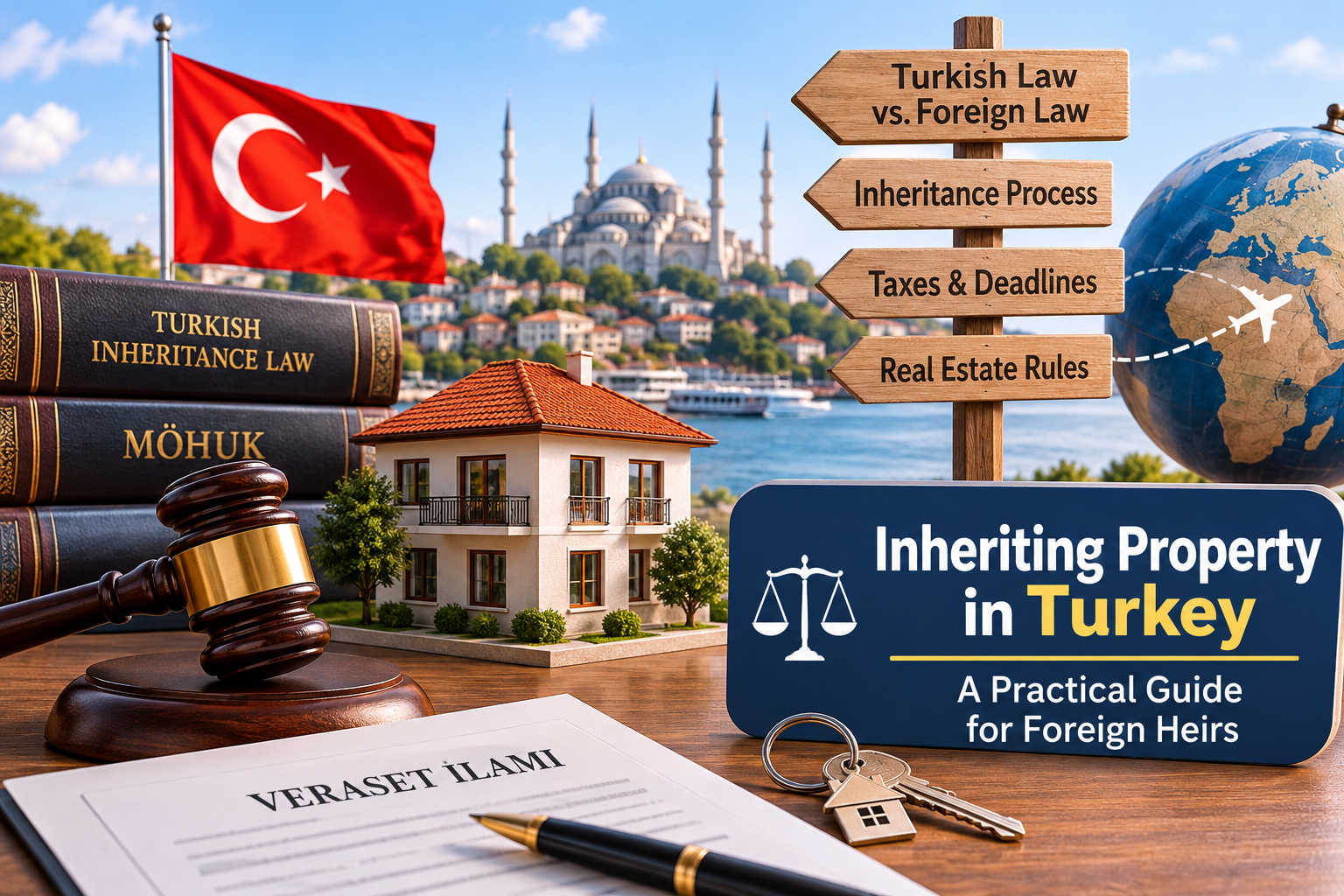
A death in the family is difficult enough on its own. When the person who died owned a flat in Antalya or a bank account in Izmir, and the heirs live in London, Berlin or Amsterdam, the paperwork can quickly feel impossible to untangle.
This guide walks through how Turkish inheritance works when a foreign element is involved. It won't replace advice on your specific file, but it should give you a clear picture of what happens, in what order, and where the usual delays come from.
Which country's law applies?
This is the first question, and the answer is often misunderstood.
Turkish courts apply the deceased's national law to the estate as a whole. If your father was a German citizen, German law governs the distribution of his assets.
There is one significant exception. Under Article 20 of the International Private and Procedural Law (MÖHUK), immovable property in Turkey is governed by Turkish law. A flat in Istanbul is divided according to Turkish inheritance rules, even if the deceased lived abroad their whole life.
In practice, this means a single estate can be split: movables follow the home country's law, while Turkish real estate follows Turkish law. That split is where most cross-border complications begin.
Who inherits under Turkish law?
Turkish law is protective of close family members. It reserves a minimum share — the saklı pay, or reserved portion — for children, the surviving spouse, and in some cases parents and siblings.
You can leave the remaining portion to whoever you wish. What you cannot do is write a will that cuts a child out entirely. A foreign will can be recognised in Turkey, but it will not override these reserved shares.
For many families this comes as a surprise, particularly where the deceased's home country allows complete freedom to disinherit.
The process, step by step
1. Obtain the death certificate.
If the death occurred abroad, you'll need an apostilled copy and a sworn translation into Turkish.
2. Get an inheritance certificate (veraset ilamı).
This is the document that officially identifies who the heirs are and in what proportions. It's the foundation of everything else.
3. Identify and list the assets.
Property, bank accounts, vehicles, company shares. Turkish banks and the land registry will each ask for the certificate before releasing anything.
4. File the inheritance tax return.
More on this below — the deadline matters.
5. Transfer the assets.
Land registry (tapu) for property, the bank for accounts.
Why the inheritance certificate usually requires a court
Where the deceased was Turkish and all heirs are in Turkey, a notary can issue the certificate. Once a foreign heir or a foreign death certificate is involved, notaries generally decline, and the file goes to the Civil Court of Peace (Sulh Hukuk Mahkemesi).
This is a non-contentious procedure, but it takes time. You'll typically need:
The apostilled and translated death certificate
Passport copies of all heirs, translated
Turkish population records for the deceased
The will, if one exists, translated
A power of attorney if you're not attending in person
Missing or improperly translated documents are the single most common cause of delay. Translators must be sworn; an ordinary translation will be rejected.
Real estate: restrictions you should know about
Foreign heirs can inherit Turkish property without restriction. Selling it is different.
Under Article 35 of the Land Registry Law, foreign nationals may acquire property only in areas open to foreign ownership — outside military security zones, and subject to reciprocity rules. Inherited property is generally exempt from these limits, but if you plan to keep or transfer it, the property still needs to sit in a permissible area.
If it doesn't, you may need to sell within a set period or hold it through a Turkish company. Worth checking before you plan around keeping the property.
Inheritance and gift tax
Turkey levies inheritance tax on the value of assets received, on a progressive scale running roughly from 1% to 10%, depending on the amount and the heir's relationship to the deceased.
The return is generally due within four months of the death becoming known, and there are penalties for late filing. Valuation is based on the declared value of the assets — for real estate, this can differ from market value, and the gap is a frequent source of disputes with the tax office.
The rules here have been amended recently. If your file involves a valuation dispute or a large estate, the current version of the legislation should be checked rather than relied on from memory.
Can you refuse an inheritance?
Yes. Turkish law allows renunciation (reddi miras) within three months of learning of the death. This matters when the estate carries more debt than assets — a mortgage, a business liability, unpaid taxes.
The three-month window is strict, and once it passes, you inherit the debts along with everything else. If the deceased's financial position is unclear, this deadline deserves immediate attention.
Do you need to travel to Turkey?
Not necessarily. Most steps can be handled through a power of attorney granted before a notary in your own country, then apostilled and translated. Choose the scope carefully — a narrow power of attorney will stall the moment an unexpected document is requested.
Court hearings in the inheritance certificate procedure are usually short, and representation is standard.
Frequently asked questions
Can a foreigner inherit property in Turkey?
Yes, without restriction. Selling it later is subject to the rules on foreign ownership.
How long does the process take?
Three to six months is typical when documents are complete. Court backlogs and missing translations push it longer.
Is a will made abroad valid in Turkey?
Generally yes, if it meets the form requirements of the country where it was made. It cannot override the reserved shares of close family members for Turkish property.
Do I pay tax in both countries?
Possibly. Turkey taxes the inheritance; your home country may also. Double taxation treaties may apply — worth checking with a tax adviser in your own jurisdiction.
What if some heirs can't be found?
The court can proceed without them in certain circumstances, but their share is held in trust. This usually requires a lawyer's involvement.
Can I sell inherited property immediately?
Once the title is transferred to your name, yes — subject to the area restrictions above.